Showing posts with label Other Locations. Show all posts

Thursday, 13 May 2010

Ben Lawers NNR

My journey home from my recent Scottish trip took me through Glen Coe and to the Ben Lawers NNR for a lunch break. Some years ago, I read about the alpine flora at Ben Lawers and I was interested to familiarise myself with the area with a view to possibly having a break there in the future.

The visitor centre was closed, which was disappointing, and I travelled on, up the mountain road beyond the centre to a damn where, to avoid the horizontal rain, I had my picnic lunch in the car. Near to where I was parked was this small clump of Purple Saxifrage (Saxifraga oppositifolio) ...


Later I parked near the visitor centre and had a short walk into part of the Reserve where I observed the following two species of lichen on a sapling. The first two pictures are of Physcia aipolia, the first 20mm in diameter, the second 20mm x 40mm. Both are young examples but have typical apothecia with their dark brown to black discs developing.


On the same tree, the following and again young, Toad lichen (Melanohalea exasperata), 20mm in diameter, well named in one sense, because I have been totally exasperated in trying to identify it and in another, because mature examples look like the skin of a toad. After posting my photographs to a Scottish Lichen group, experts have given me advice and positive identifications.


I have read recently that a tree might host as many as twenty different lichens. The picture confirms this to some extent, including the tiny crustose lichen Rinodina sophodes (top, and bottom left immediately under the M. exasperata), Xanthoria polycarpa (centre bottom under the M. exasperata), as well as a few immature lobes of a Physcia species, possibly the Physcia aipolia, as presented above.

Thursday, 6 May 2010

Glenelg Lichens

When I visited Glenelg last November I was interested to observe the large number of lichens growing on the stones and amongst the mosses which cover the boundary walls surrounding the ancient brochs. I decided that when I returned, I would like to study these in greater detail.

I have to say that learning even a little about lichens has been an interesting experience. There was such an assortment at Glenelg that I probably missed many more than I photographed. I don't believe that any I've included are particularly rare and my attempts to indentify them were neither sophisticated nor very scientific; I tried my best to navigate a way through a key and compared my photographs with those in books or on the websites of experienced lichenologists. As ever, I am happy to hear from anyone who might identify them differently.

Throughout the region, trees were found covered in these Unsea filipendula, often hanging in lengths of up to five feet as in the right-hand picture:


The following is Peltigera membranacea, olive green above (top) with cream undersides (below) ...


These are two more of the Cladonia family, both no more than 20mm tall, the first Cladonia coniocraea, the second Cladonia squamosa ...


... while the following are two Ochrolechias, the first Ochrolechia parella, the second Ochrolechia tartarea ...


This last lichen has been the hardest to identify. The Scottish Lichen Group have told me that it is Lecidea lapicida ...


Finally, this fern. I should probably have been more rigorous, conducting an intimate examination, and I'm sorry I didn't. From my limited reference sources describing ferns I would say that it looks like a spleenwort, but I can't be sure so hopefully someone will tell me ...

... My thanks to Phil Gates, who has kindly suggested Polypodium, which is common throughout Britain on wall tops, as in this case, trees and rocks. The fronds are 10-40cm long, flat and oblong, with lobes more or less equal in size. Because of the location, this example would, I think, be Common Polypody (Polypodium vulgare)

Thursday, 19 November 2009

Glen Elg

In the second of two pieces about my recent trip to Scotland, I have a little of the highland countryside to share with you.

The day following the visit to Chanonry Point was devoted to a drive into Glen Elg. The weather was much less reliable than it had been the day before and the first stop of the day, to take in the Map of Scotland view at the western end of Loch Garry, was rather overcast ...


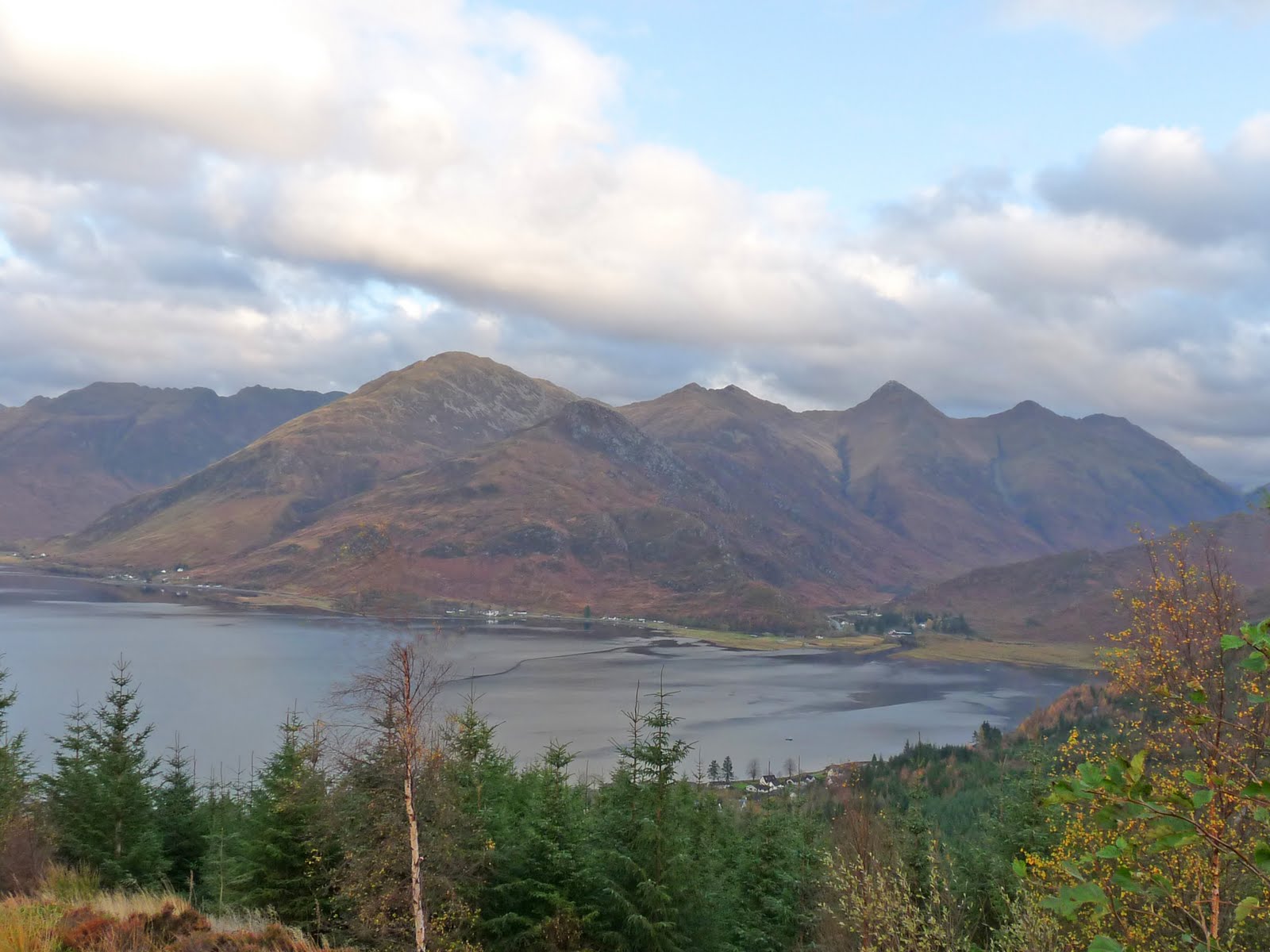
I saw a post-sitting Hooded Crow and a small group of distant Red Deer while passing Loch Cluanie. A pair of Golden Eagle, a Peregrine and numerous Buzzards were also seen. Shortly afterwards we began our climb of the Ratagan Pass where we stopped to view the Five Sisters of Kintail ...


and the view across Loch Duich to Sgurr an Airgid ...


A short stop at the Kylerhea ferry landing, opposite the Isle of Skye, in the hope of glimpsing sea otter, left us otterlessly car-bound in driving rain.

If views of wildlife were few and far between and the landscapes were not all that was hoped for because of the weather, the after-lunch visit to the Glen Elg brochs certainly provided ample compensation. The two brochs, at Dun Telve and a short distance away at Dun Troddan, are the best preserved in mainland Scotland and date from between 2,300 and 1,900 years ago.

Above: The remains of the Dun Telve broch; Below: the Dun Troddan broch


Both the brochs are twin-walled circular structures with a single doorway; off to the side of the doorway is a short passage between the walls which may have housed a guard or watchdog. Once within the inner enclosure, there is also an inner entrance leading to other passages between the curtain walls, and parts of the stairways still survive which gave access to upper levels.

Top left & right: The entrance and the 'guard-room'; Bottom left & right: An inner passage and stairs between the curtain walls and a selection of mosses and lichens growing on the walls surrounding the site.

The brochs stood around 10 metres high and both approach this height today in places. There are remains of wooden post holes at various points in the structure, and it is thought that the inner circular courtyard may have been roofed, giving comfortable living accommodation during times of attack.

It is believed that the Dun Telve broch survived almost complete until the eighteenth century when it was partly demolished for buildings nearby. The site was excavated and poorly recorded in 1914 when coarse pottery, stone tools and several lamps were found.

Monday, 16 November 2009

Chanonry Point

I visited Chanonry Point on the Black Isle last week during a short trip to Scotland. The main purpose of my visit was to look for the pod of bottlenose dolphins which live in the Moray Firth. I positioned myself on the south-eastern tip of the point with the lighthouse behind me, traditionally the best place to see the dolphins. The conditions were perfect; the Firth was quite calm and the late afternoon light was ideal for photography. Sadly, both time and the absence of an incoming tide were against me and the dolphins didn't make an appearance.

Looking towards Rosemarkie

A pair of long-tailed duck flew up the Firth towards the Kessock Bridge and a lazy common seal surfaced occasionally and glanced about. Gulls and oystercatchers were also feeding at the waters edge.

A passing Oystercatcher (Haematopus ostralegus)

Herring Gulls (Larus argentatus)

Great Black-backed gull (Larus marinus)