Showing posts with label Birds. Show all posts

Saturday, 16 June 2012

Mull Birds

During my recent tour of the west coast of Scotland, I spent an enjoyable six days on Mull. My list of birds for the sixteen days I was away numbered eighty, but the birds I saw on Mull were certainly the highlight.

In Tobermory harbour I found this Hooded Crow (Corvus cornix), feeding amongst the seaweed ...


Tobermory Harbour

At the Ulva ferry landing, I joined a small group of birdwatchers on a cruise to look for Sea Eagles on Loch na Keal.  Both the setting for the trip, and the weather, were perfect.

The view from Ulva towards Loch na Keal 
with Ben More (to the right) and surrounding mountains in the distance

Sea or White-tailed Eagle (Haliaeetus albicilla) flying over Loch na Keal

From the boat I had good views of Black Guillemot (Cepphus grylle), Great Northern Diver (Gavia immer) and Harbour Porpoise (Phocena phocena).  And though I wasn't able to visit Staffa during my stay on Mull, I did see these lava stacks, a south-shore feature of Ulva ...


While travelling along the southern coast of Mull, I found this Common Gull, nesting on the shore of Loch Spelve ...

Common Gull (Larus canus)

At Dervaig Bay, in the  north west of Mull, I found a large group of Greylag Geese feeding.

Greylag Geese (Anser anser)

Dervaig Bay

And finally, while visiting Iona, I was delighted to hear a Corncrake (Crex crex) in a field next to the abbey ...

Iona Abbey

Saturday, 4 December 2010

Bramblings in the Snow

The snow in my garden on Thursday morning was three feet deep and the most convenient way for me to feed the birds was to place small portions of their favourite foods along the top of the wall at my front door.

From my living room window I watched three male Bramblings, a large mixed flock of Chaffinch, four Greenfinch, a female House Sparrow, three male and two female Blackbirds, individual Blue, Coal and Great Tits and a Robin visit the food. As might be imagined, I was particularly pleased to see the Bramblings. I think this is a first winter male ...

Brambling (Fringilla montifringilla)

Wednesday, 1 December 2010

Hard Times

Since the weekend, the winter weather, which was at least picturesque in my last my last piece, has continued to tighten it's grip on Redesdale. The accumulation now is certainly as deep as last winter and clearing it has meant a lot of hard work for me and my new plastic snow shovel. The car-wide track down to the road, created on Saturday when I dug out the six inches of snow lying on my drive, has filled and been cleared twice again; on Monday the snow was twelve inches deep and there was another six inches yesterday. And if I felt up to the task this morning, five inches more has fallen overnight. It's still snowing heavily as I write so I've voted for a lazy day. Sadly, the garden birds will not be able to relax.

Monday, 12 April 2010

Kirkwhelpington

Kirkwhelpington is thought to be a settlement of Anglo-Saxon origin. The parish church dates from 1210 and is dedicated to St. Bartholomew; it's graveyard is the resting place of Sir Charles Parsons, the celebrated Tyneside engineer and shipbuilder.

The source of the River Wansbeck is found near Sweethope Lough, in the midst of the wild Wannies moorland to the west of the village, but it is still hardly more than a tumbling stream as it meanders though the peaceful farmland to the south of the village.

A gated lane leaves the village to the east and a walk there, alongside the Wansbeck, is always productive.

The lane beside the Wansbeck

Chiffchaffs were calling from high in the road-side trees, making them difficult to photograph:

Chiffchaff (Phylloscopus collybita)

Fortunately, the flowers on the verges and amongst the trees were more obliging:

Lesser Celandine (Ranunculus ficaria)

Wood Anemone (Anemone nemorosa)

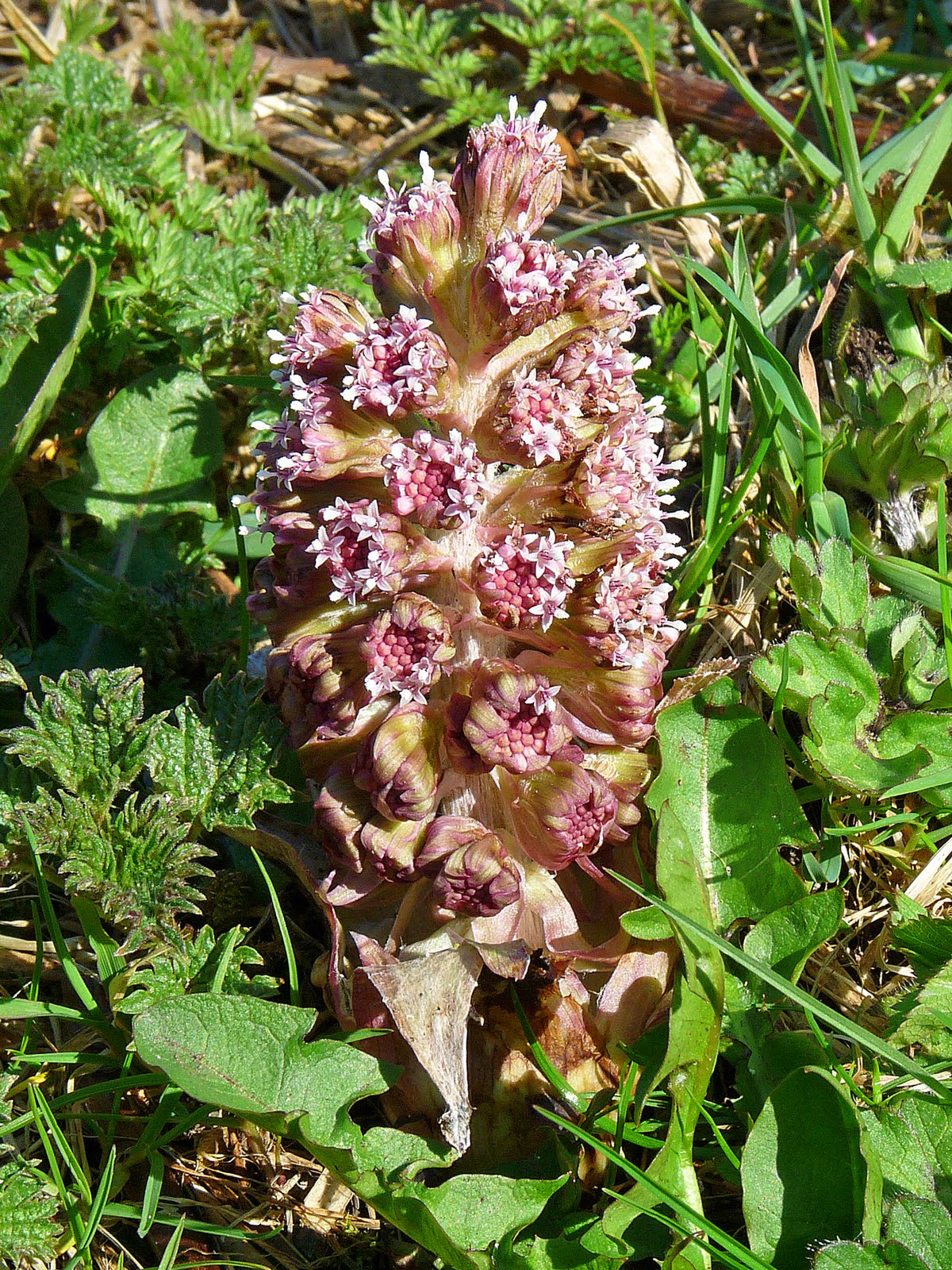
Butterbur (Patasites hybridus)

Dog's Mercury (Mercurialis perennis)

My journey home took me along the old enclosure road beside Harwood Forest where this Brown Hare crossed my path and settled long enough to have its picture taken:

Brown Hare (Lepus capensis)

Saturday, 28 November 2009

Wallington West Woods

I enjoyed a very pleasant afternoon at the observation hide in Wallington's West Woods yesterday. The weather was fine, if suddenly very much colder after the recent mild spell.

Activity at the two feeders was frenetic: Chaffinch, Nuthatch, Robin and Blue, Great and Coal Tits were all regular visitors. Happily, the ground-feeding chaffinches were joined by a group of four Brambling; I was particularly pleased to these as they are still to return to my Redesdale garden this year. Two male Great Spotted Woodpecker's were present and a Jay put in an occasional appearance. A single Red Squirrel popped in and out to feed from nuts it found on the ground.

A male Brambling (Fringilla montifringilla)

A male Great Spotted Woodpecker (Dendrocopus major)

Red Squirrel (Sciurus vulgaris)

I include a picture of the Jay (Garrulus glandarius), only because I am pleased to have photographed one for the first time (it's certainly no prize winner).

Monday, 16 November 2009

Chanonry Point

I visited Chanonry Point on the Black Isle last week during a short trip to Scotland. The main purpose of my visit was to look for the pod of bottlenose dolphins which live in the Moray Firth. I positioned myself on the south-eastern tip of the point with the lighthouse behind me, traditionally the best place to see the dolphins. The conditions were perfect; the Firth was quite calm and the late afternoon light was ideal for photography. Sadly, both time and the absence of an incoming tide were against me and the dolphins didn't make an appearance.

Looking towards Rosemarkie

A pair of long-tailed duck flew up the Firth towards the Kessock Bridge and a lazy common seal surfaced occasionally and glanced about. Gulls and oystercatchers were also feeding at the waters edge.

A passing Oystercatcher (Haematopus ostralegus)

Herring Gulls (Larus argentatus)

Great Black-backed gull (Larus marinus)

Tuesday, 28 July 2009

An Unexpected Meeting

After my visit to Falstone Moss, I travelled home by Sidwood and Black Middens. I had seen a male Emerald Damselfly at Sidwood on an earlier visit and hoped to find it again and take a better picture. There was no sign of the male but a female put in an appearance and made a very fine study on the grass she settled on ...

Emerald Damselfly (Lestes Sponsa)

Black Middens, as you will know if you have been following my recent pieces, is just across the Tarset Burn from Sidwood. I travelled up the valley towards Comb, at the end of the metalled lane where the forestry tracks begin. Someone had told me I might expect to find dragonflies in one of the lane-side fields. As I approached the field, my attention was distracted by animal activity at the side of the lane ahead of me. And then, after a moment and walking down the lane towards me, was a young badger. It was about five in the afternoon.

I stopped, hardly able to believe what I was seeing. Perhaps I should have just taken its picture through the car windscreen and hoped for the best. I reached for my camera, however, and gently opened the car door. By this time the badger was sitting at the side of the lane, its head raised as if sniffing me out. On putting a first foot outside of the car, it disappeared into the undergrowth and down the bank towards the burn.

There were no dragonflies in the field but the sighting of the badger more than made up for their absence. Later, I stopped to photograph a Small Tortoiseshell, basking in the sun ...

Small Tortoiseshell (Aglais urticae)

And this Pied Wagtail, standing on a fence post, finished off a good afternoon.

Pied Wagtail (Motacilla alba)

Sunday, 19 July 2009

The Curlew

There can be few sounds more evocative of an upland spring than the haunting, falling call of the curlew. For many, it is the first sign of the season's arrival; a hopeful moving-on from winter.

Here in Redesdale, curlews are all around during their breeding season and at all times of day. Often, on a still night, I have the midnight chime at St. John's in the village on one side and a curlew calling from the moors on the other.

The Tynedale poet Wilfrid Wilson Gibson was moved sufficiently by the curlew's call to write:

That note - that note!
Comes there so clear a call from any throat,
So clear a call to me
Back to the hills, the hills of memory?

The curlew's call
Is April sunshine on cold fells, and all
Rapture of youth to me,
Calling me to the hills, the hills of memory.

Curlew (Numenius arquata)

W. W. Gibson's poem Curlew is included in a collection of his work entitled Homecoming, published by the Wagtail Press in 2003 to celebrate the 125th anniversary of his birth in Hexham. It is included here with the publisher's permission.

Monday, 29 June 2009

Views of Upper Coquetdale

The visitor to Upper Coquetdale, whatever their interest, will be seldom disappointed. My two visits during the last week included views of a fine-looking Grey Heron, flying up from the river bank onto a nearby grassy slope ...

Grey Heron (Ardea cinera)

A Common Sandpiper calling from its perch on a fence ...

Common Sandpiper (Actitis hypoleucos)

And lots of young Wheatears.

Wheatear (Oenanthe oenanthe); a juvenille

Along the Coquet there were clumps of Blotched Monkey Flower, garden escapees relocated now in splashes of mustard and blood-red cheerfulness on the river bank ...

Blotched Monkey Flower (Mimulus luteus)

River Water Crowfoot, and their reflections, in the river itself ...

River Water Crowfoot (Ranunculus fluitans)

And Wild Thyme clinging to a sunny, bank-side rock.

Wild Thyme (Thymus polytrichus)

Saturday, 20 June 2009

Redstarts at Black Middens

Without any particular plan, I ventured today into the remote and beautiful country surrounding the Tarset Burn and the ruined bastle house at Black Middens. The Tarset Burn is a tributary of the North Tyne and because there is only a single-track road into and out of the valley, people seem to pass it by.

In the woodland at Black Middens I watched a pair of Redstarts feeding at least four young. These were the best views I have had of Redstarts in many years. There was also a very active family of Treecreepers in the wood, which added to the pleasure.

A short way down the road, a finger post directed me through a gate and across a field to a path through more old woodland on the burn side. I watched a pair of Grey Wagtails on the burn and was eaten alive by midges while standing still for half-an-hour trying to photograph a Wren.

Redstart (Phoenicurus phoenicurus)

Redstart (Phoenicurus phoenicurus): the female I think

The Tarset Burn

Grey Wagtail (Montacilla cinerea)

It may be of interest to know that bastle houses are numerous along the border between England and Scotland. They are defensible farmhouses, defensible that is against raids by reivers between the thirteenth and sixteenth century. Bastle houses are characterised by stone walls often a metre thick, a generally vaulted ground floor where livestock was housed for safe keeping and family accommodation on the first floor accessed by a ladder which was pulled up from the inside at night (the ground floor entrance and external staircase shown in the picture below were probably additions after peace came to the Borders in the early seventeenth century). The windows were usually narrow slits and the roof would be made of stone slates. Today, most bastle houses are in complete ruin, some like Black Middens have only their walls standing, others in better repair are still used as store houses on farms and some are converted into comfortable homes.

Black Middens bastle house

Friday, 12 June 2009

The Early Bird

I have all the windows open to the fresh air this morning and the sounds of birdlife are all around. Somewhere amongst the buttercup-filled pastures to the west, curlews are calling; their haunting, falling call one of the great pleasures of an upland spring. And occasionally too, I hear the faint piping of an oystercatcher in the opposite direction towards the River Rede. Earlier, a linnet sat on the sunny ridge of a neighbour’s roof; its breast so puffed up in song that it looked exactly as if it were wearing a Pickwickian-red waistcoat, two or three sizes too small. In the garden, coal and blue tits, siskins and a solitary female redpoll, a nuthatch and a great spotted woodpecker, chaffinches and goldfinches are visiting the feeders and bird table, flitting hurriedly in and out again with food for young which I think I can sometimes hear nearby but can never see through the mass of leaves which now cover the poplars. And then, into the midst of this harmony, a jackdaw elbows in, frightening away all the small birds to tension-filled waiting areas in the surrounding trees before casually stepping onto the peanut feeder and breakfasting on the nuts.

I don’t suppose this behaviour is based on anything other than opportunism; the jackdaw sees the chance of an easy meal and takes it. And for all their strutting style, I still prefer jackdaws to starlings; I just wish they would go and feed somewhere else!

The Jackdaw (Corvus monedula) on the peanut feeder

Thursday, 4 June 2009

Wallington West Woods

I enjoyed a walk in the West Woods at Wallington Hall this afternoon. All the common woodland species were about but the highlight was a group of six Stock Doves. They were gleaning an area near the visitor hide, filling their crops with the sunflower seeds dropped by the finches, tits and nuthatches visiting the feeders. There was also a fine Robin and a male Great Spotted Woodpecker. The latter was particularly active, moving from tree to tree and calling all the time. A group of noisy Rooks also put in an appearance; not very exciting perhaps but I've not photographed any of the corvids before so the picture below is one for the collection.

Stock Dove (Columba oenas)

Robin (Erithacus rubecula)

Great Spotted Woodpecker (Dendrocopus major)

Rook (Corvus fruilegus)

Friday, 29 May 2009

Bakethin

I have been in a different direction again today, following the North Tyne to Kielder Water and beyond to Bakethin, a conservation area on the edge of Kielder village.

Bakethin was created in 1979 with the construction of a dam across the North Tyne which flooded part of the valley up stream; the dam is near to the now submerged Bakethin farm. From the start, Bakethin was developed as a special conservation area within the larger Kielder Water scheme.

The site offers a range of habitats including grassland, coniferous and broad-leafed woodland, heathland and marsh. Much is promised in the available literature but, despite hearing the yaffle of a green woodpecker at the car park just after I arrived, a good sign I thought, it turned out to be a rather lean day for observations.

A short walk through mixed woodland, where I watched a Robin feeding a single fledging, brings you to a hide which conveniently overlooks three islands that have been constructed in a bay on the southern edge of the lake. One island is topped with a shingle mound, ideal for breeding wading species including the pair of Oystercatchers seen today. On another island, a holt was built to encourage otters which have bred at the site.

A view of the three islands from the Bakethin hide

Apart from a small number of Sandmartins and a Heron flying over, the only birds seen at the lake were Mallard. I had a fleeting glimpse of a Great Spotted Woodpecker when retracing my steps to the car park.

The path to the hide

I won't give up on Bakethin; I think it is well worth follow-up visits at different times of the year and certainly an earlier visit next year. And today, a long sit in the hide provided a perfect shelter from the worst of the afternoon sun and allowed time to practice my digiscoping skills with my Nikon ED50 fieldscope (see my earlier article entitled An Introduction to Digiscoping):

Oystercatcher (Haematopus ostralegus)

Oystercatcher with Mallard (Anas platyrhynchos)