Showing posts with label Common Sandpiper. Show all posts

Friday, 3 June 2011

Kinloch Hourn

I wonder how many times we pass the end of a road without giving a second thought to where it might lead or what delights we might find were we to follow it? The road to Kinloch Hourn proved to be such a road during my recent Scottish trip.

Turning off the Skye road beyond Invergarry, the road to Kinloch Hourn begins in a wooded lane which hugs the northern shore of Loch Garry for five or so miles to the hamlet of Tomdoun with its delightful little church. Five miles on, when you come to the tiny settlement of Kingie at the head of Loch Garry you are already in the wilderness and amongst the high hills of Glenquoich.

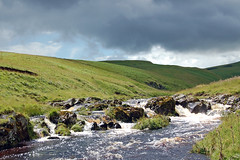
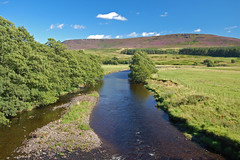
Glenquoich, the River Garry above Kingie and the Knoydart hills beyond

The views in all directions and the barren remoteness of Glenquoich revived long-unvisited memories of backpacking days in the Western Highlands more than twenty years ago. On this day, however, as I dawdled on along the single track road, taking in the splendour of it all, I could happily acknowledge that the road was more easily travelled from behind the steering wheel.

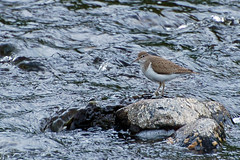
A Common Sandpiper (Actitis hypoleucos) on the northern bank of the River Gary

In the 1950's, the glen was dammed beyond Kingie raising the waters of the existing Loch Quoich by one hundred feet: sadly, it suffers today from the same unnatural shape and scarred, low-water shore line of many other man-made lakes. On rocky rain-washed outcrops near the dam, I found many Common Butterwort (Pinguicala vulagaris). It was the first time I had seen these stickily hairy carnivorous perennials ...

Common Butterwort (Pinguicala vulagaris)

Other plants seen included these Lousewort (Pedicularis sylvatica) ...


... these Thyme-leaved Milkwort (Polygala serpyllifolia)


... and these fungi


The Red Deer, featured in my last piece, were found near the head of Loch Quoich. Further on still, the steep descent to the road end at Kinloch Hourn begins (the link to the Undiscovered Scotland pages provides further information and pictures). The settlement comprises one or two houses and a farm, the latter offering food and basic accommodation for hill walkers, climbers, cyclists and exploring motorists! A path along the southern shore of Loch Hourn takes walkers to Barrisdale and on into the Knoydart peninsula while another path along the northern shore, takes walkers to Arnisdale and Glen Elg.

Near the end of my journey and before the steep descent into Kinloch Hourn, at the foot of the dark hill to the left of centre in this picture, this view over Loch Coire Shubh opened up

Monday, 29 June 2009

Views of Upper Coquetdale

The visitor to Upper Coquetdale, whatever their interest, will be seldom disappointed. My two visits during the last week included views of a fine-looking Grey Heron, flying up from the river bank onto a nearby grassy slope ...

Grey Heron (Ardea cinera)

A Common Sandpiper calling from its perch on a fence ...

Common Sandpiper (Actitis hypoleucos)

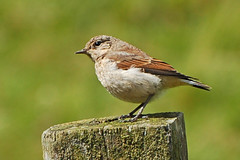
And lots of young Wheatears.

Wheatear (Oenanthe oenanthe); a juvenille

Along the Coquet there were clumps of Blotched Monkey Flower, garden escapees relocated now in splashes of mustard and blood-red cheerfulness on the river bank ...

Blotched Monkey Flower (Mimulus luteus)

River Water Crowfoot, and their reflections, in the river itself ...

River Water Crowfoot (Ranunculus fluitans)

And Wild Thyme clinging to a sunny, bank-side rock.

Wild Thyme (Thymus polytrichus)

Tuesday, 12 May 2009

Tod Law


Tod Law
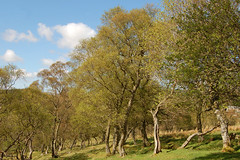
A corner of the birch woodland at Tod Law

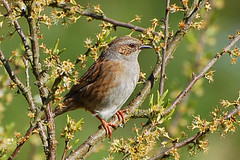
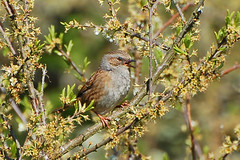
I enjoyed my walk this afternoon around the open woodland at Tod Law, near the village of Rochester in Upper Redesdale (I say 'open woodland' because there is also a fine enclosed wood on Tod Law which I did not venture into). Birds seen included Cuckoo and Tree Pipit, Willow Warbler, Chiffchaff, Wren, Dunnock, tits and finches. A Heron flew up from the River Rede as I approached and a Common Sandpiper flew in but neither dippers nor wagtails were about. Most of the birds were too far away to photograph except for the Dunnock.

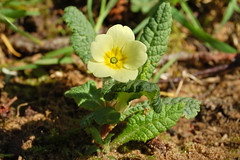
It's the first time I've visited the woodland and I think it's probably worth a regular visit; certainly there are parts I didn't go to today which could be explored on a return visit. Wild flowers were rather limited, although there were primroses amongst the trees on the river bank and marsh marigolds under the bank itself.

Dunnock (Prunella Modularis)
Dunnock (Prunella modularis)

Dunnock (Prunella modularis)
A Dunnock (Prunella modularis) singing at Tod Law

Primrose (Primula vulgaris)


The ford on the River Rede at Tod Law

Friday, 1 May 2009

Upper Coquetdale

"The Coquet has its source far up amongst the Cheviot Hills. That part of the valley known as Upper Coquetdale is a wide tract of hill country lying on the north-western border of Northumberland, extending for a distance of some twenty-five miles eastward from the head of the Coquet."

David 'Dippie' Dixon introduces the area thus in his renowned book Upper Coquetdale, first published in 1903. The valley today is still a place "rife with historic associations". Dixon adds: "Throughout the length and breadth of this charming bit of Northumberland, whether it be amid the wide expanse of its heathery moorlands or the grandeur of its lofty hills, in it rocky ravines and wooded dells, the lover of nature will find an ample field of enjoyment and research."

I visit Upper Coquetdale regularly, grateful that it is, so to speak, just on my doorstep. My knowledge of its wildlife seems to grow with every visit.

River Coquet
The river Coquet, seen here in spate beside Kateshaw Crag,
eight miles from its source near the Scottish border.


Common Sandpiper (Actitis hypoleucos)
A Common Sandpiper (Actitis hypoleucos) seen on the river
in spring and summer.


Holystone Burn
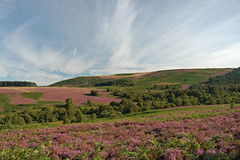
Heather moorland beside the Holystone Burn

Wheatear (Oenanthe oenanthe)
A juvenille Wheatear (Oeanthe oeanthe)

River Coquet at Hepple Bridge
The river flows lazily at Hepple Bridge