Showing posts with label Chiffchaff. Show all posts

Monday, 12 April 2010

Kirkwhelpington

Kirkwhelpington is thought to be a settlement of Anglo-Saxon origin. The parish church dates from 1210 and is dedicated to St. Bartholomew; it's graveyard is the resting place of Sir Charles Parsons, the celebrated Tyneside engineer and shipbuilder.

The source of the River Wansbeck is found near Sweethope Lough, in the midst of the wild Wannies moorland to the west of the village, but it is still hardly more than a tumbling stream as it meanders though the peaceful farmland to the south of the village.

A gated lane leaves the village to the east and a walk there, alongside the Wansbeck, is always productive.

The lane beside the Wansbeck

Chiffchaffs were calling from high in the road-side trees, making them difficult to photograph:

Chiffchaff (Phylloscopus collybita)

Fortunately, the flowers on the verges and amongst the trees were more obliging:

Lesser Celandine (Ranunculus ficaria)

Wood Anemone (Anemone nemorosa)

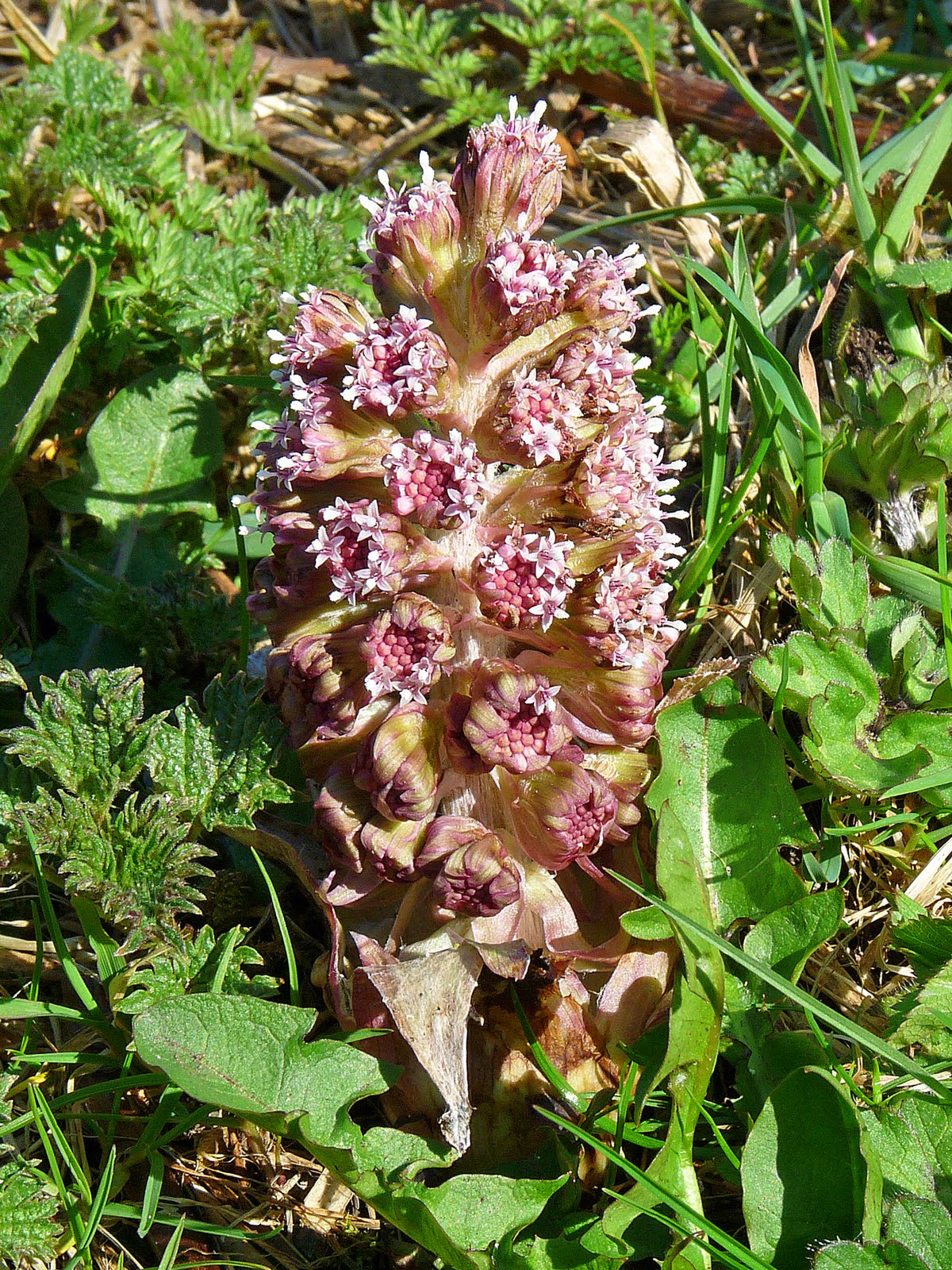
Butterbur (Patasites hybridus)

Dog's Mercury (Mercurialis perennis)

My journey home took me along the old enclosure road beside Harwood Forest where this Brown Hare crossed my path and settled long enough to have its picture taken:

Brown Hare (Lepus capensis)

Monday, 25 May 2009

Yetholm Loch

I've been across the Scottish border today with my friend Harold, to visit Yetholm Loch. It's a beautiful and utterly peaceful place, lying in a small crescent-shaped valley on the northern edge of the Cheviot Hills.

After leaving the Rede valley and crossing the border at Carter Bar, we took the quiet road north, following the Kale Water through the hills to Hownam and Town Yetholm (not far from Kirk Yetholm, at the northern end of the Pennine Way).

Yetholm Loch is described in Birdwatching in the Scottish Borders as an "open body of water with associated swamp, fen and carr woodland habitats". The site is managed by the Scottish Wildlife Trust. The loch is approached along stretches of board walk through dense woodland and a grassy field-side path which brings you at last to a hide offering wide views across the water and the surrounding hills.

Looking across the western side of the loch from the hide

Willow Warbler and Chiffchaffs were singing in the woodland and in the willow carr and we watched Reed Bunting and Sedge Warbler in the reed mace at the edge of an adjoining lochan. From the hide, we had good views of an over-flying heron, a distant buzzard and Mute Swans, Greylag Geese, Mallard and a pair of Gadwall on the water. At one point, when a disturbance in the reeds near the hide set up a small flight of Mallard, we half-expected to see the resident otter emerge after them. Sadly, it didn't.

I had no luck photographing the Sedge Warblers today but Harold has kindly offered one of his lovely pictures:


Sedge Warbler (Acrocephalus schoenobaenus)

Naturally, the Mute Swans were as photogenic as ever:

Mute Swan (Cigus olor)

Mute Swan (Cigus olor)

Friday, 22 May 2009

Garden Birds

It's five and a half years since I moved to the Rede valley and, coming here from a small house with an almost birdless back-yard garden in the suburbs of Newcastle upon Tyne, it has always been a pleasure, and sometimes a great surprise, to watch the various birds that visit or fly over my garden. I am lucky here to have a small mixed wooded area immediately in front of the house which includes white poplars and Scots pine and provides cover for the birds when visiting the feeders.

Very occasionally, a new bird is added to the list; the stars this year have been the Redpolls that appeared out of the blue on the first day I put up my new nyjer seed feeder in late February. Long-tailed tits also found, but seem subsequently to have forgotten their way to the garden this year. It's not a very large list, some 40 species at most, but when the weather or something else stops me from going out, they all help brighten the day.

The list includes the males, females and young of most but not all of the following: Greenfinch, Goldfinch and Chaffinch; Brambling, Siskin and Redpoll; Coal, Blue, Great and Long-tailed tits; Blackbird, Song Thrush and Fieldfare; Reed Bunting and House Sparrow; Willow Warbler and Chiffchaff; Pied Wagtail, Wren, Robin, Dunnock and Nuthatch; Great Spotted Woodpecker and Tree Creeper; Tawny Owl and Sparrow Hawk; Rook, Carrion Crow and Jackdaw; Starling and Pheasant with Heron, Swallow, House Martin, Swift and Buzzard flying overhead.

Greenfinch (Carduelis chloris)

Goldfinch (Carduelis carduelis)

Blue Tit (Parus caeruleus)

Pied Wagtail (Motacilla alba)

Great Spotted Woodpecker (Dendrocopos major)

Tuesday, 12 May 2009

Tod Law


Tod Law
A corner of the birch woodland at Tod Law

I enjoyed my walk this afternoon around the open woodland at Tod Law, near the village of Rochester in Upper Redesdale (I say 'open woodland' because there is also a fine enclosed wood on Tod Law which I did not venture into). Birds seen included Cuckoo and Tree Pipit, Willow Warbler, Chiffchaff, Wren, Dunnock, tits and finches. A Heron flew up from the River Rede as I approached and a Common Sandpiper flew in but neither dippers nor wagtails were about. Most of the birds were too far away to photograph except for the Dunnock.

It's the first time I've visited the woodland and I think it's probably worth a regular visit; certainly there are parts I didn't go to today which could be explored on a return visit. Wild flowers were rather limited, although there were primroses amongst the trees on the river bank and marsh marigolds under the bank itself.

Dunnock (Prunella Modularis)
Dunnock (Prunella modularis)

Dunnock (Prunella modularis)
A Dunnock (Prunella modularis) singing at Tod Law

Primrose (Primula vulgaris)


The ford on the River Rede at Tod Law

Sunday, 3 May 2009

Wandering the Wansbeck

Leaving Kirkwhelpington by the gated lane to Wallington, I stopped by the side of the River Wansbeck thinking I might see a dipper. Sadly there was no dipper, but a pair of grey wagtails were feeding on the river side, a Blackcap was singing across the water, a male Redpoll trilled high in a tree behind me and Willow Warblers and Chiffchaffs were calling from every direction. Then, a robin, which had been flitting in and out of the hawthorn beside me for some time, forgot about insects for a moment, perched and sang its heart out.

Robin (Erithacus rubecula)
Robin (Erithacus rubecula), singing in the hawthorn

Grey Wagtail (Motacilla cinera)
A female Grey Wagtail (Motacilla cinera)

I took time to enjoy the flowers today, having overlooked them for too long on my wanderings. There was a wonderful carpet of bluebells in the laneside wood with cowslips popping up amongst them, their complementing colours splashed by thin shafts of sunlight breaking through the undergrowth. And I was delighted to see water avens, with their nodding, bell-shaped flowers, and ferns, twirled as tight as a Bishop's crook, on the verge of unfolding. Butterflies included large and green-veined white, peacock, orange tip and small tortoiseshell. So, birds, flowers and butterflies; a perfect and peaceful afternoon.

Blue Bell (Endymion non-scriptus)
Bluebell (Endymion non-scriptus)

Water Avens (Geum rivale)
Water avens (Geum vivale)

Cowslip (Primula veris)

Fern
Lots of ferns unfolding

Small White (Pieris rapae)
Green-veined White (Pieris napi)

The picture of the Grey Wagtail was digiscoped. All of the other pictures were taken with my Nikon D50.