Showing posts with label Flowers. Show all posts

Monday, 4 June 2012

An Atlantic Oakwood

One of the great pleasures of travelling is that you never know what you might find around the next corner. Ariundle Oakwoood, an Atlantic Oakwood on the outskirts of the pretty village of Strontian in Sunart, was one such surprise on my recent Scottish trip.  And Sunart is one of the few areas in Scotland that retain their ancient oakwoods, now so rare they are protected.

Ariundle is a precious fragment of an immense oakwood that once cloaked Europe's Atlantic coast from Portugal to Norway.  Here, the steep lochside has been wooded since the glaciers retreated some 12,000 years ago. A lush covering of mosses, lichens and liverworts flourish in this undisturbed world in the Strontian Glen.  The trees are mostly sessile oak, which do well on the acid soils that cover the granite bedrock.  Other native species include holly, hazel, birch, rowan, alder, willow, ash and wych elm.

Ancient oakwoods such as Ariundle have played an important part in the natural and human history of the area for thousands of years.  In the eighteenth and nineteenth centuries, the trees were coppiced for charcoal burning and the remains of old charcoal burning platforms can still be found in the wood.  The fallen trees and their dead wood provide food for spiders, beetles and insects such as wood ants.

Above Left: Evidence of coppiced oaks can still be seen
Above Right: Tree Lungwort (Lobaria pulmonaria)

The oakwood in single tree:
Wood Sorrel (Oxalis acetosella) growing amongst moss with a Peltigera lichen to the left

The woodland floor: 
Primrose (Primula vulgaris) and one of my favourites, a Lousewort (Pedicularis sylvatica)

Cladonia squamosa


Monday, 22 November 2010

Longhorn Beetle at Sidwood

In July, on the same day that I found the Scorpionfly at Sidwood, I came across another interesting insect, a Longhorn Beetle (Pachytodes cerambyciformis) feeding on what I thought was Feverfew (Chrysanthemum parthenium) but I am grateful to Stewart Sexton who tells me is Sneezewort (Achillea ptarmica), described below.


The best habitats for finding longhorn beetles are flowery woodland rides or edges, flower-rich meadows or roadsides near woodland, such as here at Sidwood, or marshy areas. Only a few species are common in very built up areas, gardens, coastal habitats and heath land.

Regarding Sneezewort, its leaves can be eaten raw or cooked. They are cardiac, diaphoretic, digestive, emmenagogue, odontalgic, sternutatory and styptic. The leaf is chewed to relieve toothache and can be used as an insect repellent. The dried, powdered leaves are used as a sneezing powder. The plant yields an essential oil that is used medicinally.

Tuesday, 1 June 2010

Black Middens Flowers

I wandered up and down the quiet lane at Black Middens yesterday afternoon, between the Tarset Burn and Comb, looking for flowers and butterflies. Sadly the Orange Tip avoided me again, but only just; I did get very near to photographing one.

The flowers were more obliging even though it was rather breezy. This Yellow Archangel (Lamiastrum galobdolon) was a new-for-me species ...


And these are the best of the rest:

Water Avens (Geum rivale)

Cuckooflower or Lady's Smock (Cardamine pratensis)

Greater Stitchwort (Stellaria holostea)

Marsh Marigold (Caltha palustris)

Crosswort (Cruciata laevipes)

A this past-its-best Bugle (Adjuga pertans)


As ever, if I have identified any of the flowers incorrectly, please do let me know.

Monday, 12 April 2010

Kirkwhelpington

Kirkwhelpington is thought to be a settlement of Anglo-Saxon origin. The parish church dates from 1210 and is dedicated to St. Bartholomew; it's graveyard is the resting place of Sir Charles Parsons, the celebrated Tyneside engineer and shipbuilder.

The source of the River Wansbeck is found near Sweethope Lough, in the midst of the wild Wannies moorland to the west of the village, but it is still hardly more than a tumbling stream as it meanders though the peaceful farmland to the south of the village.

A gated lane leaves the village to the east and a walk there, alongside the Wansbeck, is always productive.

The lane beside the Wansbeck

Chiffchaffs were calling from high in the road-side trees, making them difficult to photograph:

Chiffchaff (Phylloscopus collybita)

Fortunately, the flowers on the verges and amongst the trees were more obliging:

Lesser Celandine (Ranunculus ficaria)

Wood Anemone (Anemone nemorosa)

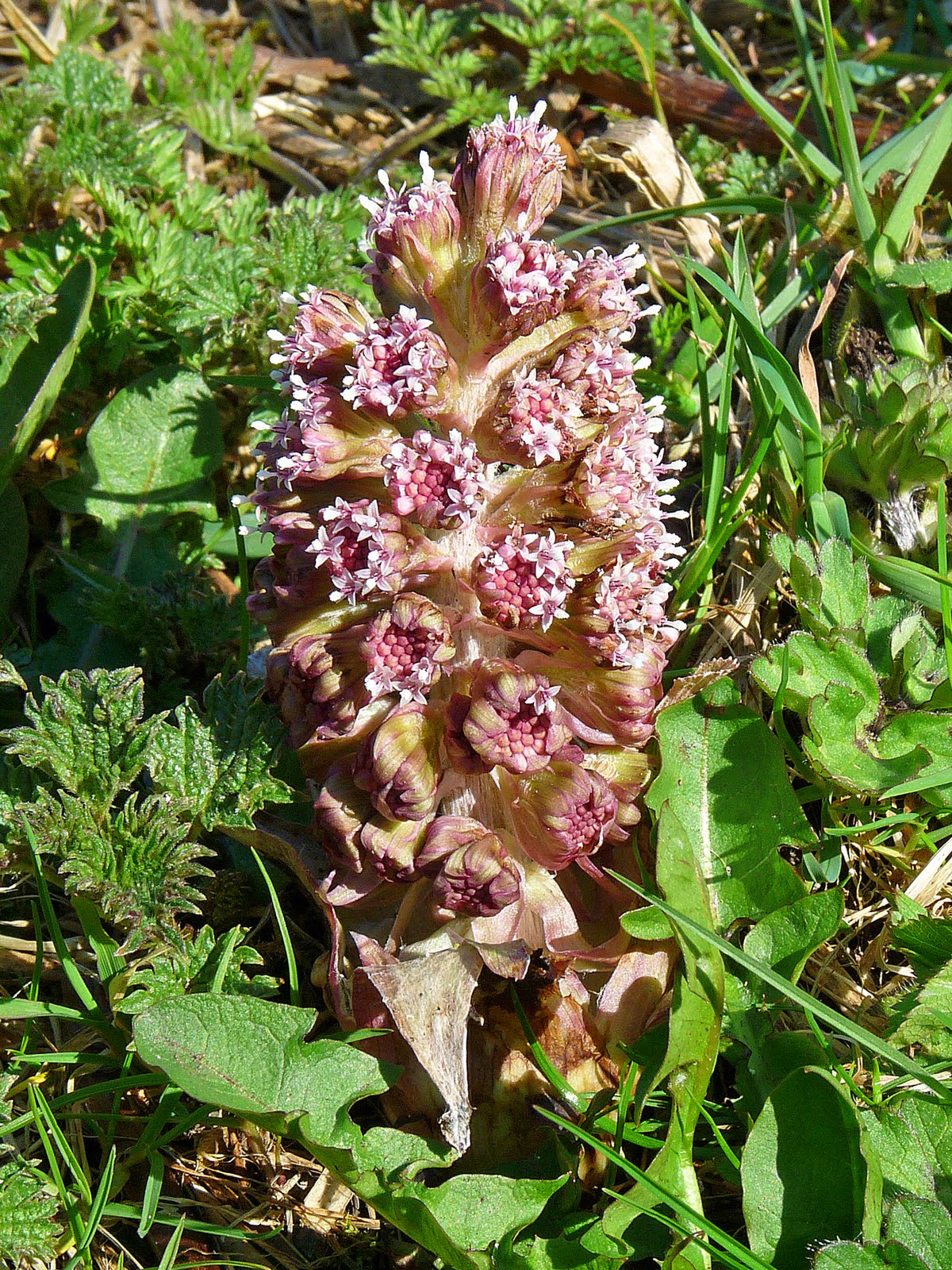
Butterbur (Patasites hybridus)

Dog's Mercury (Mercurialis perennis)

My journey home took me along the old enclosure road beside Harwood Forest where this Brown Hare crossed my path and settled long enough to have its picture taken:

Brown Hare (Lepus capensis)

Sunday, 26 July 2009

Falstone Moss

Falstone Moss is 825 feet above sea level and receives about forty inches of rain annually. The peat in its centre is about twenty feet deep and began to form about 8,000 years ago.

The Moss is rain-fed and sits in a shallow depression surrounded by forest that has been planted on drier ground. It is one of nearly sixty Border Mires in Kielder Forest. Because of their cool, wet climate, the British Isles contain much of the world's blanket bogs and, as a result, the Border Mires are of international importance. The Moss includes plants that can tolerate the combined stresses of a cool climate, a high water table, high acidity and low fertility.

The small lake at the centre of the Moss

The Moss is reached by following a wet and overgrown up-hill moorland path and a lengthy board walk which ends at, and surrounds, the lake shown above. I hoped that my visit would provide views of dragon and damselflies.

There were a number of common blue damselflies about; unfortunately none were near enough to photograph. I had a fleeting glimpse of one unidentified darter dragonfly, a pale brown species, but happily, Common Hawkers were about in good numbers; I counted ten together at one point, flying over the water or the Moss, either individually or paired in tandem mating.

I had not watched dragonflies in this setting or in these numbers before and it was an experience I very much enjoyed. I sat on the board walk for a good hour taking-in all of the views. At one point, a pair of meadow pipits flew in, settling amongst the rushes on the lake-side. Although it seemed unlikely, I wondered if they might regard the dragon or damselflies as a handy food source. However, their interest in the place was only as somewhere to bathe and they each spent a minute or two, splashing about in the shallows at the lake edge before flying off across the Moss.

I was particularly interested in the noise made when the dragonflies flew near to the vegetation on the banks of the lake and surprised they did not seem to damage their wings when doing so; I can only liken it to the annoying sound of someone rustling a crisp packet in a cinema. A pair of Common Hawkers did settle in the undergrowth near to me at one point, mating in a wheel.

Common Hawker (Aeshna juncea)

On my way off the Moss I stopped to photograph some of the flowers including cotton grass, cross-leaved heath and the heather which was starting to flower. I was also interested to see Bilberries in fruit.

Bilberry (Vaccinium myrtillus)

I returned home via Sidwood and Black Middens of which more next time.

Thursday, 23 July 2009

More of Sidwood

Here are some more of the pictures from my walk at Sidwood. The first is a female of one of the common bumble bees (Bombus lucorum).

Bumble Bee (Bombus lucorum)

Of the following two, one I think is a bee and the other a hover fly. Both are yet to be identified, so if there is a reader able to help I would be pleased to hear from you.


The insects here, and the butterflies pictured in my previous piece, seemed to be making the most of the flowers and the warm, sunny afternoon. The Ragwort was especially popular ...

Ragwort (Senecio jacobaea)

But the other plants, amongst them this Common Knapweed, also had many visitors.

Common Knapweed (Centaurea nigra)

Friday, 10 July 2009

Golden-rod

Golden-rod (Solidago virgaurea) is a perennial herb up to 85cm tall with erect, simple or branched stems. This plant was pictured in open woodland at Allen Banks and I am grateful to both Phil Gates and Roy Norris for their guidance in identifying it.

Historically, the plant has been used in folk medicine; the flowering heads are collected before they are fully developed and dried in shade. The drug contained has been used in numerous brands of proprietary medicine prescribed for kidney and bladder disorders, arthritis and rheumatism. In homoeopathy an essence, based on fresh material, is given for the same ailments. A weak infusion can be taken as a diuretic or used externally as a stronger infusion to bathe slow-healing cuts, burns and eczema. There are no known harmful side effects.

Golden-rod (Solidago virgaurea)

Thursday, 9 July 2009

Allen Banks

The historic woodland at Allen Banks was given to the National Trust in 1942 by the Bowes-Lyon family and has a long and varied history. The 'Wilderness Walks' were created between 1830 and 1860 to provide a wild contrast to the formal parkland and gardens surrounding Ridley Hall; they include bridges across the River Allen, flights of stone stairs from the river bank to the higher parts of the woods, an artificial pond, seats and several scenic viewpoints along the valley. Today, the woodland remains a peaceful place to walk and observe the natural world.

The River Allen near Raven Crag

My interest focused again on some the plant life:

Herb Robert (Geranium robertianum)

Common Spotted Orchid (Dactylorhiza fuchsii)

Enchanter's Nightshade (Circaea lutetiana)

Beech nuts (Fagus sylvatica)

Despite my best endeavours, I am unable to positively identify the following but I think this plant is Common St. John's Wort (Hypercium perforatum) ...


And this is the seed head of a Rough Hawkbit (Leontondon hispidus) ...


Further information about Allen Banks can be found here

Sunday, 5 July 2009

Cottonshope Burn

The sykes and springs which feed the Cottonshope Burn are on the high ground near to the Roman road known as Dere Street and not far from the Roman fort at Chew Green, itself just on the English side of the border with Scotland and very near to the source of the River Coquet. A narrow road, starting at Cottonshopeburnfoot and climbing steadily, leads the traveller north, through part of the Forestry Commission's Byrness plantation and into a wide-valley wilderness grazed by Cheviot and Black-faced sheep.

I recently bought a revised edition of Francis Rose's The Wild Flower Key, and have been trying to master the mysteries of wild flower identification. I took some pictures in the valley of flowers I've not previously photographed: Self-heal I already knew and I used the keys in the book to identify two others. If I am wrong, please do let me know. All of the flower pictures were taken using my Nikkor 18-55mm lens and a 6 dioptre close-up lens.

Self-heal (Prunella vulgaris)

Lousewort (Pedicularis sylvatica)

Common Mouse-ear (Cerastium fontanum)

I found a male Ringlet amongst the long grass on the plantation edge ...

Ringlet (Aphantopus hyperantus)

... And this Foxlove.

Foxglove (Digitalis purpurea)

Addendum, 6 July, 2009: Thanks to Phil Gates, a botanist at Durham University, who redirected my initial identification of a supposed Lesser Stitchwort to that of a Common Mose-ear (see above).

Monday, 29 June 2009

Views of Upper Coquetdale

The visitor to Upper Coquetdale, whatever their interest, will be seldom disappointed. My two visits during the last week included views of a fine-looking Grey Heron, flying up from the river bank onto a nearby grassy slope ...

Grey Heron (Ardea cinera)

A Common Sandpiper calling from its perch on a fence ...

Common Sandpiper (Actitis hypoleucos)

And lots of young Wheatears.

Wheatear (Oenanthe oenanthe); a juvenille

Along the Coquet there were clumps of Blotched Monkey Flower, garden escapees relocated now in splashes of mustard and blood-red cheerfulness on the river bank ...

Blotched Monkey Flower (Mimulus luteus)

River Water Crowfoot, and their reflections, in the river itself ...

River Water Crowfoot (Ranunculus fluitans)

And Wild Thyme clinging to a sunny, bank-side rock.

Wild Thyme (Thymus polytrichus)

Saturday, 27 June 2009

Barrowburn Hay Meadows (3)

Although it was hot and sunny during my second visit to the hay meadows at Barrowburn, it was also quite breezy. I had travelled in hope of photographing some of the insects that visit the meadows, particularly the Chimney Sweeper moth pictured below, and the bumble bees. And from reading the SSSI description, I had tagged the grasses present on site in my field guide and planned to try photographing them too. However, as there were not as many of the moths and bees about and the steady breeze kept the grasses on the move, both these objectives were made difficult if not impossible to fulfil. So, as well as having a very nice lunch at the Barrowburn Farm tea room, I spent the afternoon happily sauntering the hay meadow paths and photographing the flowers again.

Foxglove (Digitalis purpurea) on the meadow edge

Ox-eye Daisy (Leucanthemum vulgare)

Meadow Vetchling (Lathyrus pratensis)

Wood Crane's Bill (Geranium sylvaticum)

Chimney Sweeper Moth (Odezia atrata)