Showing posts with label Ringlet. Show all posts

Thursday, 14 July 2011

Widdrington Tip

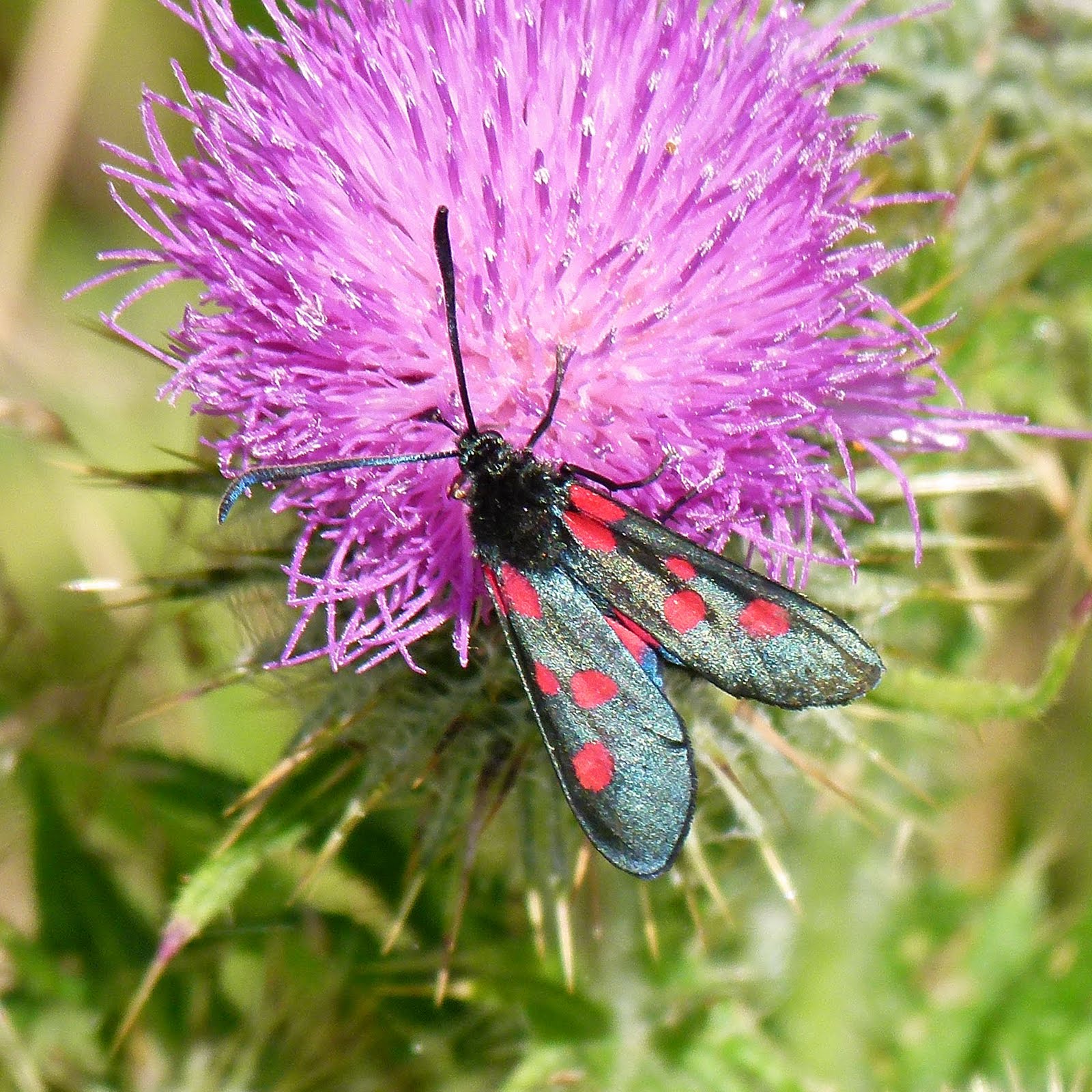
I paid a visit to this interesting area this week and must thank Stewart Sexton for sending a map and directions which proved most useful. I hoped to see butterflies and wasn't disappointed; Meadow Brown, Ringlet, Common Blue and a great number of Small Skippers were on the wing. And, for the first time in, let me think ... it must be thirty years, I saw and photographed a Six-spot Burnet moth.

Six-spot Burnet (Zyganena filipendulae)

Small Skipper (Thymelicus sylvestris)


Common Blue (Polyomatus icarus)

I also came upon this Mallow growing in the track-side verge. I thought it was a Musk Mallow but it is not so hairy and the upper leaves were deeply cut so I take it to be a Cut-leaved Mallow (Malva alcea) ...

Wednesday, 21 July 2010

Common Blue at Sidwood

There's been strong wind and quite a lot of rain in the valley recently so, taking advantage of the first fine day to dawn in the last two weeks, I had a drive to Sidwood this afternoon and added a new butterfly to my list, a Common Blue (Polyommatus icarus).


Ringlets, Meadow Browns and Small Skippers were also flying.

Ringlet (Aphanotopus hyperantus)

Small Skipper (Thymelicus sylvestris)

Sidwood - a peaceful place for a saunter

Tuesday, 21 July 2009

Sidwood

Sidwood is a large area of open-access woodland managed by the Forestry Commission and is part of the larger Kielder Forest. It is on the western side of the Tarset Burn, just over the water from the bastle at Black Middens, and can be reached by a walk through fields and a footbridge crossing the burn. Alternatively, a narrow lane from Redheugh, north of Greenhaugh, leads you directly to a small car park at Sidwood itself from where the whole area can be explored.

One of the attractions at Sidwood is a fine piece of mixed woodland running along-side the Tarset Burn which includes some ancient trees and ornamental species that remain from the old Sidwood estate.

The path through the burn-side woodland at Sidwood

Immediately beside the car park there was grassy a path leading away to what must have once been the ornamental pond on the old Sidwood estate. Here I watched Southern Hawker dragonflies beside a small stream and pictured one of them when it rested on a stinging nettle.

Southern Hawker (Aeshna cyanea)

The woodland walk was delightful, particularly the burn-side stretches, but it was finding large numbers of ringlets and meadow browns amongst the flowers on the verges of the lane leading back to the car park, that really made the day. After all the wet weather during the last week, they were taking full advantage of the bright, warm sunshine.

Ringlet (Aphantopus hypercantus)

Ringlet (Aphantopus hypercantus)

Meadow Brown (Maniola jurtina)

Meadow Brown (Maniola jurtina)
Sunday, 5 July 2009

Cottonshope Burn

The sykes and springs which feed the Cottonshope Burn are on the high ground near to the Roman road known as Dere Street and not far from the Roman fort at Chew Green, itself just on the English side of the border with Scotland and very near to the source of the River Coquet. A narrow road, starting at Cottonshopeburnfoot and climbing steadily, leads the traveller north, through part of the Forestry Commission's Byrness plantation and into a wide-valley wilderness grazed by Cheviot and Black-faced sheep.

I recently bought a revised edition of Francis Rose's The Wild Flower Key, and have been trying to master the mysteries of wild flower identification. I took some pictures in the valley of flowers I've not previously photographed: Self-heal I already knew and I used the keys in the book to identify two others. If I am wrong, please do let me know. All of the flower pictures were taken using my Nikkor 18-55mm lens and a 6 dioptre close-up lens.

Self-heal (Prunella vulgaris)

Lousewort (Pedicularis sylvatica)

Common Mouse-ear (Cerastium fontanum)

I found a male Ringlet amongst the long grass on the plantation edge ...

Ringlet (Aphantopus hyperantus)

... And this Foxlove.

Foxglove (Digitalis purpurea)

Addendum, 6 July, 2009: Thanks to Phil Gates, a botanist at Durham University, who redirected my initial identification of a supposed Lesser Stitchwort to that of a Common Mose-ear (see above).