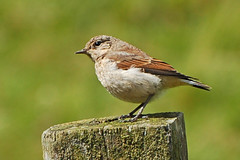
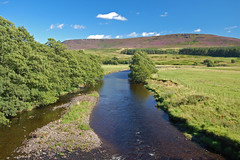
Friday, 22 May 2009

Garden Birds

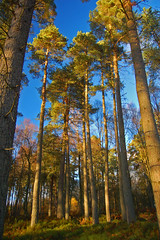
It's five and a half years since I moved to the Rede valley and, coming here from a small house with an almost birdless back-yard garden in the suburbs of Newcastle upon Tyne, it has always been a pleasure, and sometimes a great surprise, to watch the various birds that visit or fly over my garden. I am lucky here to have a small mixed wooded area immediately in front of the house which includes white poplars and Scots pine and provides cover for the birds when visiting the feeders.

Very occasionally, a new bird is added to the list; the stars this year have been the Redpolls that appeared out of the blue on the first day I put up my new nyjer seed feeder in late February. Long-tailed tits also found, but seem subsequently to have forgotten their way to the garden this year. It's not a very large list, some 40 species at most, but when the weather or something else stops me from going out, they all help brighten the day.

The list includes the males, females and young of most but not all of the following: Greenfinch, Goldfinch and Chaffinch; Brambling, Siskin and Redpoll; Coal, Blue, Great and Long-tailed tits; Blackbird, Song Thrush and Fieldfare; Reed Bunting and House Sparrow; Willow Warbler and Chiffchaff; Pied Wagtail, Wren, Robin, Dunnock and Nuthatch; Great Spotted Woodpecker and Tree Creeper; Tawny Owl and Sparrow Hawk; Rook, Carrion Crow and Jackdaw; Starling and Pheasant with Heron, Swallow, House Martin, Swift and Buzzard flying overhead.
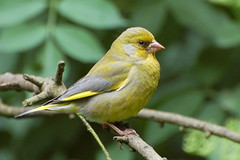
Greenfinch (Carduelis chloris)

Goldfinch (Carduelis carduelis)

Blue Tit (Parus caeruleus)
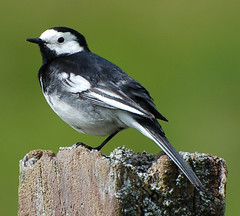

Pied Wagtail (Motacilla alba)

Great Spotted Woodpecker (Dendrocopos major)
Sunday, 17 May 2009

Whinchats & Meadow Pipits

It was a good day for birds but not such a good day to picture them.

I heard my first Cukoo of the day only a mile from home at Hopefoot, in the woodland skirting the Otter Burn. This was followed by a Buzzard post-perching at Hopehead, and Oystercaters, Lapwing and Curlew in the pastures near Craig, on route to Coquetdale.

I have a favourite stopping place beside a small wet heather moor just beyond North Yardhope; here, in spring and summer, I always look for Whinchats and am seldom disappointed. There was an active pair there today, both perching conspicuously on prominant twigs of heather or on the wire stock fence on the moor's southern boundary. All the while, Cuckoos were calling from woodlands to the north and south.

I tried digiscoping some pictures of the Whinchats from the open car window using a bean bag to support the fieldscope and camera. The birds were probably one hundred and fifty yards away at this point and it was no surprise that the pictures were unsuccessful. Afterwards, I tried to get closer, covering the tripod, fieldscope and camera with some camouflage scrim in an effort to break up its outline, and my own, as I moved slowly through the heather towards the birds. I managed one average picture before they took off.

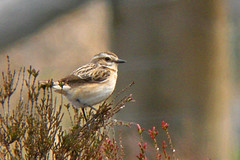
Whinchat (Saxicola rubetra)
A female Whinchat (Saxicola rubetra)

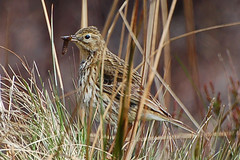
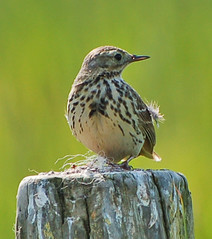
At mid-day, a Meadow Pipit settled in the grass very close to me. It was carrying food to its young in a nearby nest. During the afternoon, I watched it and its mate return regularly to the nest with food.

Meadow Pipit (Anthus pratensis)

The return journey to Redesdale followed the Holystone Burn and the River Coquet, with a quick stop to view a toddler Lapwing in the fields near Holystone Grange, and then the Grasslees Burn to Billsmoor Foot and Elsdon.

Tuesday, 12 May 2009

Tod Law


Tod Law
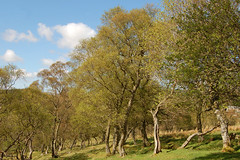
A corner of the birch woodland at Tod Law

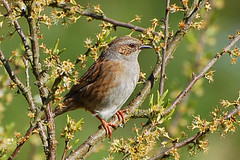
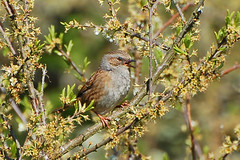
I enjoyed my walk this afternoon around the open woodland at Tod Law, near the village of Rochester in Upper Redesdale (I say 'open woodland' because there is also a fine enclosed wood on Tod Law which I did not venture into). Birds seen included Cuckoo and Tree Pipit, Willow Warbler, Chiffchaff, Wren, Dunnock, tits and finches. A Heron flew up from the River Rede as I approached and a Common Sandpiper flew in but neither dippers nor wagtails were about. Most of the birds were too far away to photograph except for the Dunnock.

It's the first time I've visited the woodland and I think it's probably worth a regular visit; certainly there are parts I didn't go to today which could be explored on a return visit. Wild flowers were rather limited, although there were primroses amongst the trees on the river bank and marsh marigolds under the bank itself.

Dunnock (Prunella Modularis)
Dunnock (Prunella modularis)

Dunnock (Prunella modularis)
A Dunnock (Prunella modularis) singing at Tod Law

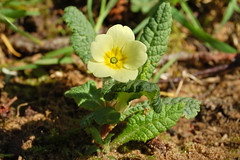
Primrose (Primula vulgaris)


The ford on the River Rede at Tod Law

Friday, 8 May 2009

Tuppence a Bag

It's a long time since you could feed the birds for tuppence a bag. These days, the supply of wild bird food is big business and the food itself comes in 20kg sacks with prices to match. And there's more: We lovingly provide our feathered friends with somewhere to perch, drink and bathe, often much better facilities than they enjoy in their own homes, and there are feeders especially designed for almost every kind of bird food you can imagine (well if you supply the food, why not create special feeders in which to serve it).

I bought my friend Sandra a bird feeder for her birthday last December. It was a small, yellow, wooden house enclosing a house-shaped cake of bird food. She loved it of course, and placed it near her kitchen window so she could watch the birds when she was washing the dishes. I think it was the sight of a nuthatch feeding that initially captured her attention and which led her one day to buy another feeder, and then another, until now she has quite a collection. And all of the time, she is attracting more species into her garden. Her excitement was dangerously infectious when we last spoke, to arrange a birdwatching day out as you might expect, and we spent as much time comparing notes about the birds that visit our respective gardens as a pair of thirteen-year-olds might about the boy next door.

And yet, this doesn't stop us from wanting the best we can afford for the birds we welcome into our gardens, and not least because of the pure, old-fashioned, pleasure they provide. Long may it continue.

Hard times for this Blue Tit (Parus caeruleus): Winter feeding is particularly important

Nuthatch (Sitta europaea)

Siskin (Carduelis spinus)

Sunday, 3 May 2009

Wandering the Wansbeck

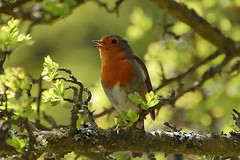
Leaving Kirkwhelpington by the gated lane to Wallington, I stopped by the side of the River Wansbeck thinking I might see a dipper. Sadly there was no dipper, but a pair of grey wagtails were feeding on the river side, a Blackcap was singing across the water, a male Redpoll trilled high in a tree behind me and Willow Warblers and Chiffchaffs were calling from every direction. Then, a robin, which had been flitting in and out of the hawthorn beside me for some time, forgot about insects for a moment, perched and sang its heart out.

Robin (Erithacus rubecula)
Robin (Erithacus rubecula), singing in the hawthorn

Grey Wagtail (Motacilla cinera)
A female Grey Wagtail (Motacilla cinera)

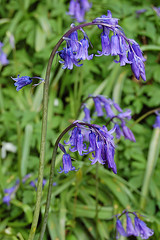
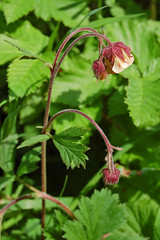
I took time to enjoy the flowers today, having overlooked them for too long on my wanderings. There was a wonderful carpet of bluebells in the laneside wood with cowslips popping up amongst them, their complementing colours splashed by thin shafts of sunlight breaking through the undergrowth. And I was delighted to see water avens, with their nodding, bell-shaped flowers, and ferns, twirled as tight as a Bishop's crook, on the verge of unfolding. Butterflies included large and green-veined white, peacock, orange tip and small tortoiseshell. So, birds, flowers and butterflies; a perfect and peaceful afternoon.

Blue Bell (Endymion non-scriptus)
Bluebell (Endymion non-scriptus)

Water Avens (Geum rivale)
Water avens (Geum vivale)

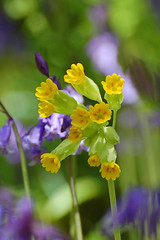
Cowslip (Primula veris)

Fern
Lots of ferns unfolding

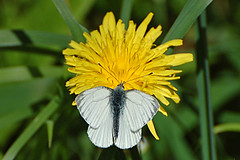
Small White (Pieris rapae)
Green-veined White (Pieris napi)

The picture of the Grey Wagtail was digiscoped. All of the other pictures were taken with my Nikon D50.

Saturday, 2 May 2009

Redesdale

My friend Beryl Charlton, in her book The Story of Redesdale, says: "The jewel in Redesdale's crown is it's history, for this is the valley which is richer in story and ballad than any other in England. Prehistoric people built their settlements here, the Romans established themselves at High Rochester and buried their dead in a cemetery near by. The most bitter battle in the medieval Anglo-Scottish wars was fought in Otterburn and the Border Reivers carried on their deadlie feuds from strongholds in the valley. The 17th century Covernanters held seccret meetings in the hills, whisky smugglers and drovers used the old Roman road of Dere Street and the body of the murderer William Winter was hung on the gibbet above Elsdon. The violence and stubborn courage, bloodshed and romance, triumphs and tragedies continue to excite the imagination of historians, novelists and poets".

The valley is also a place of great natural beauty, especially for those who seek it out. Kingfishers and herons patrol the river Rede and red squirrels are found in its woodland. And in spring and summer, the haunting call of breeding curlews is all around. Sadly, too many pass through without noticing in their haste to reach Scotland, just over the hill pass at Carter Bar at the valley head.

River Rede
The River Rede

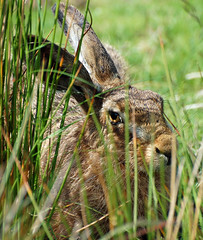
Brown Hare (Lepus capensis)

Meadow Pipit (Anthus pratensis)

Rupert's Wood
Rupert's Wood

Friday, 1 May 2009

Upper Coquetdale

"The Coquet has its source far up amongst the Cheviot Hills. That part of the valley known as Upper Coquetdale is a wide tract of hill country lying on the north-western border of Northumberland, extending for a distance of some twenty-five miles eastward from the head of the Coquet."

David 'Dippie' Dixon introduces the area thus in his renowned book Upper Coquetdale, first published in 1903. The valley today is still a place "rife with historic associations". Dixon adds: "Throughout the length and breadth of this charming bit of Northumberland, whether it be amid the wide expanse of its heathery moorlands or the grandeur of its lofty hills, in it rocky ravines and wooded dells, the lover of nature will find an ample field of enjoyment and research."

I visit Upper Coquetdale regularly, grateful that it is, so to speak, just on my doorstep. My knowledge of its wildlife seems to grow with every visit.

River Coquet
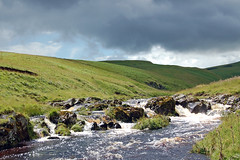
The river Coquet, seen here in spate beside Kateshaw Crag,
eight miles from its source near the Scottish border.


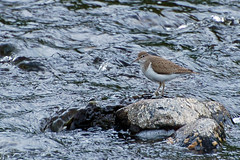
Common Sandpiper (Actitis hypoleucos)
A Common Sandpiper (Actitis hypoleucos) seen on the river
in spring and summer.


Holystone Burn
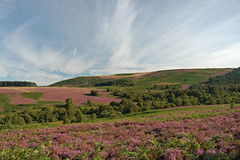
Heather moorland beside the Holystone Burn

Wheatear (Oenanthe oenanthe)
A juvenille Wheatear (Oeanthe oeanthe)

River Coquet at Hepple Bridge
The river flows lazily at Hepple Bridge