Wednesday, 28 April 2010

The Pictures to 'A Perfect Highland Day'

The first set of pictures from my recent trip to the west coast of Scotland highlights the splendid highland scenery seen during my day in Glenelg.

The view across Loch Loyne towards the snow-capped Beinn Loinne (right, behind the spur) and the long ridge of Druim nan Cnamh to the south of Loch Cluanie

Looking across Loch Hourn, near Arnisdale, towards Barrisdale Bay and the Knoydart mountains

An atmospheric view of Eigg at the entrance to the Sound of Sleat

A Feral Goat kid (Capra hircus) seen in road-side undergrowth in Glen Shiel

A Red Deer hind (Cervus elaphus) seen near the road in Glen Shiel

Thursday, 22 April 2010

A Perfect Highland Day

Last night I stood on the shore of Loch Oich and watched the ripples reflect the golden shades of the hillside opposite. It was the end to a perfect highland day.

Staying with a friend in Invergarry, we had travelled through Glen Shiel and over the Mamratagan Pass into Glenelg. It was one of those highland days that stick in your mind; sleet and mist at the start and, by the time we had crossed the pass, sunny with patches of blue sky promising a day-long improvement.

With snow-capped mountains all around us, the views of Skye, across the Sound of Sleat, were stunning. We made our way to the Glenelg brochs where I wanted to look again at the lichens and mosses which cover the boundary walls.

After lunch we followed the shore road along Loch Hourn to Arnisdale. The afternoon light was a perfect accompaniment to the triptych that opened before us: the mass of Knoydart across the loch to the left; Eigg, at the entrance of the Sound of Sleat, in the centre; and the Black Cuillin ridge on Skye to the right. 'Breathtaking' seemed hardly sufficient.

Returning through Glen Shiel we had close views of a small herd of feral goats, with kids following, and a hundred or more red deer. Birds during the day included buzzard, loch-side grey herons, a pair of goosander and hooded crow.

More to follow, including pictures, when I return home to Redesdale.

Friday, 16 April 2010

An Upland Wood

I took a drive this afternoon, following the route of last September's Sunday Drive.

It started well: a buzzard was being mobbed by a Kestrel above Hopefoot and just before High Carrick farm, a stoat ran across my path and under the road-side bushes. Later, in sight of the ruins of High Shaw bastle, I spent a gentle two hours walking in a small mixed wood I've not visited before. Here I heard my first Willow Warbler of the year, watched six Redpolls feeding in a dense thicket, noted a number of Peacock butterflies and watched bees feeding on Pussy Willow catkins.

Pussy Willow (Salix caprea)

A female Bombus lucorum feeding on the female pussy willow catkins

I am grateful to both Harold Dobson and Phil Gates for making suggestions as to the identity of the following catkins. Harold thought they were Alder (Alnus glutinosa) and Phil suggested Hazel (Corylus avellana)(see Phil's comment below)

On a nearby tree I found this common lichen, Yellow Scales (Xanthoria parietina) ...

... and on the upstanding roots of a wind-blown pine, this moss which I think is Ceratodon purpureus

Of the birds seen, this male Chaffinch was the most obliging ...

Monday, 12 April 2010

Kirkwhelpington

Kirkwhelpington is thought to be a settlement of Anglo-Saxon origin. The parish church dates from 1210 and is dedicated to St. Bartholomew; it's graveyard is the resting place of Sir Charles Parsons, the celebrated Tyneside engineer and shipbuilder.

The source of the River Wansbeck is found near Sweethope Lough, in the midst of the wild Wannies moorland to the west of the village, but it is still hardly more than a tumbling stream as it meanders though the peaceful farmland to the south of the village.

A gated lane leaves the village to the east and a walk there, alongside the Wansbeck, is always productive.

The lane beside the Wansbeck

Chiffchaffs were calling from high in the road-side trees, making them difficult to photograph:

Chiffchaff (Phylloscopus collybita)

Fortunately, the flowers on the verges and amongst the trees were more obliging:

Lesser Celandine (Ranunculus ficaria)

Wood Anemone (Anemone nemorosa)

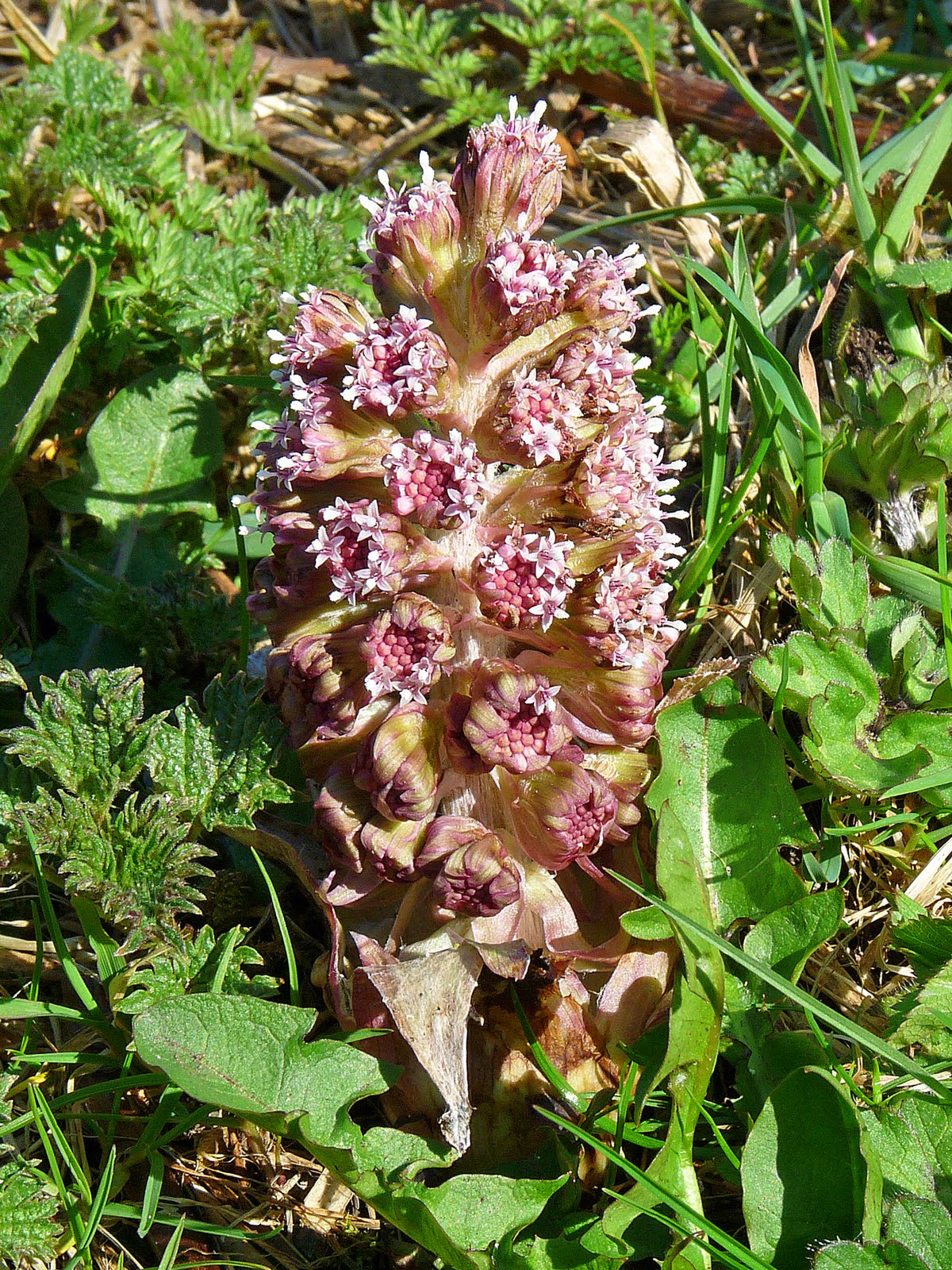
Butterbur (Patasites hybridus)

Dog's Mercury (Mercurialis perennis)

My journey home took me along the old enclosure road beside Harwood Forest where this Brown Hare crossed my path and settled long enough to have its picture taken:

Brown Hare (Lepus capensis)

Sunday, 3 January 2010

A Redwing in my Redesdale Garden

It's been snowing off-and-on in Redesdale since mid-December. The last week has seen the heaviest falls and there is as much as a foot of snow in parts of my garden today. Naturally, the birds welcome any opportunity for an easy meal and the four feeders are being filled daily.

The list today included a pair of Brambling, the first of the winter in the garden, Great Spotted Woodpecker, Blackbird, Chaffinch, Greenfinch, Goldfinch, Robin, Coal, Blue and Great Tits, Rook and Starling. A heron flew over at lunch time. But the greatest surprise of all the visitors today was a single Redwing (Turdus iliacus).

I had cleared the snow from the steps at my front door this morning and put out handfulls of a bird table seed mixture I was given at Christmas and some peanuts, chopped finely in the food processor. It was here, on the steps and just under my living room window, that the Redwing appeared. It's the first I've seen in the garden since moving into the valley more than six years ago.

I took the following pictures through my living room window; I didn't want to open the window for fear of frightening it away.


Saturday, 28 November 2009

Wallington West Woods

I enjoyed a very pleasant afternoon at the observation hide in Wallington's West Woods yesterday. The weather was fine, if suddenly very much colder after the recent mild spell.

Activity at the two feeders was frenetic: Chaffinch, Nuthatch, Robin and Blue, Great and Coal Tits were all regular visitors. Happily, the ground-feeding chaffinches were joined by a group of four Brambling; I was particularly pleased to these as they are still to return to my Redesdale garden this year. Two male Great Spotted Woodpecker's were present and a Jay put in an occasional appearance. A single Red Squirrel popped in and out to feed from nuts it found on the ground.

A male Brambling (Fringilla montifringilla)

A male Great Spotted Woodpecker (Dendrocopus major)

Red Squirrel (Sciurus vulgaris)

I include a picture of the Jay (Garrulus glandarius), only because I am pleased to have photographed one for the first time (it's certainly no prize winner).

Wednesday, 25 November 2009

Fungi

A small selection of Fungi pictures taken in Coquetdale and Redesdale.

Hypholoma capnoides

Stag's Horn

Granny's Bonnet

Sulphur Tip

Below, Dr. Gordon Beakes, of Newcastle University, describing Granny's Bonnet fungi on a decaying branch in Rupert's Wood, Redesdale, during a visit to the wood by members of the Redesdale Society. Rupert's Wood is a large ancient woodland which forms part of Lord Redesdale's estate.